

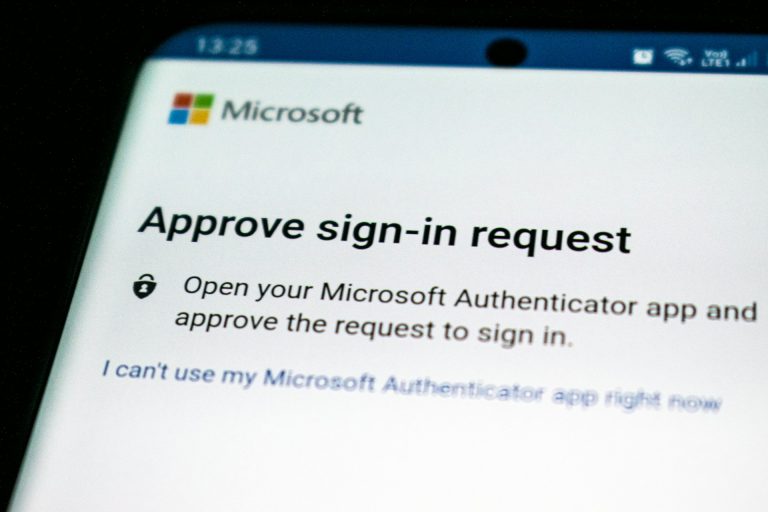
A stolen password used to be enough to compromise an account. It often still is, unless multi-factor authentication is standing in the way. MFA is one of the simplest, highest-impact security controls in use today, and understanding how it actually works, not just that it exists, is foundational knowledge for anyone entering IT or cybersecurity.
Multi-factor authentication requires a user to verify their identity using two or more independent factors before gaining access to an account or system, rather than a password alone. The logic is straightforward: even if an attacker steals a password through phishing or a data breach, they still need the second factor to get in.
| Factor Type | Description | Examples |
| Something you know | Knowledge-based factor | Password, PIN, security question |
| Something you have | Possession-based factor | Authenticator app, hardware security key, one-time SMS code |
| Something you are | Biometric factor | Fingerprint, facial recognition, retina scan |
True multi-factor authentication combines factors from at least two different categories. A password plus a PIN is not MFA, since both fall under “something you know.” A password plus a code from an authenticator app is MFA because it combines two distinct factors.
Compromised credentials remain one of the leading causes of successful breaches, largely because passwords are reused, phished, or exposed in unrelated data leaks. MFA does not make an account unbreakable, but it removes the single point of failure a password alone represents. This is why MFA implementation is one of the first recommendations in nearly every security framework and a frequent finding in security audits when it is missing.
For a SOC analyst, MFA also generates useful signals: repeated failed MFA prompts or an approval from an unfamiliar location are common indicators of an account under active attack, and monitoring for exactly this pattern is a standard part of the job.
Attackers have adapted to widespread MFA adoption with a technique called MFA fatigue, or push bombing: repeatedly sending push notification requests until an exhausted or confused user approves one by mistake. This has become a documented factor in several high-profile breaches and is a good example of why user awareness training remains necessary even after strong technical controls like MFA are in place.
MFA and identity and access management concepts appear directly on CompTIA Security+ exam objectives, and Network+ covers the networking side of implementing access controls. Both are covered under CIAT’s Unlimited Certification Exam Policy.
Learn the access control fundamentals cybersecurity roles depend on.
Two-factor authentication is a specific type of multi-factor authentication that uses exactly two factors. MFA is the broader term and can include two or more.
It is better than no MFA at all, but it is considered the weakest common method due to SIM-swapping vulnerabilities. Authenticator apps or hardware keys are generally recommended when available.
Yes, through methods like MFA fatigue attacks, SIM swapping, or session token theft, though these require significantly more effort than simply stealing a password. MFA substantially raises the difficulty of a successful attack even though it is not absolute protection.
Yes, in some form. MFA is foundational knowledge in identity and access management expected across nearly every entry-level and mid-level cybersecurity role.




401 Mile of Cars Way #100, National City, CA 91950
1717 Louisiana Blvd., NE., Suite 208 Albuquerque, NM, 87110
California Institute of Applied Technology participates in the State Authorization Reciprocity Agreements.
© 2026 California Institute of Applied Technology | info@ciat.edu | (877) 559 - 3621 | Privacy Policy
California Institute of Applied Technology has shared ownership and management of two distinct institutions. California Institute of Applied Technology located in California, and California Institute of Applied Technology located in New Mexico.
GI Bill® is a registered trademark of the U.S. Department of Veterans Affairs (VA). More information about education benefits offered by VA is available at the official U.S. government website at https://www.benefits.va.gov/gibill. CIAT is approved to offer VA benefits. Financial aid is available for those who qualify.
* Students are encouraged to take certification exams while actively enrolled in their Bootcamp, Certificate or Degree program. Unlimited certification exam attempts expire 180 days after program completion. Select exams are not eligible for unlimited retakes - see certification exam policy for details. Industry certifications and/or courses may change at any time to address industry trends or improve student outcomes.
